oem-odm · B2B PROCUREMENT
Sleeve Print T-Shirt Manufacturer: Arm Graphics Guide
By Weavnora · Updated
Direct answer
What buyers need to know
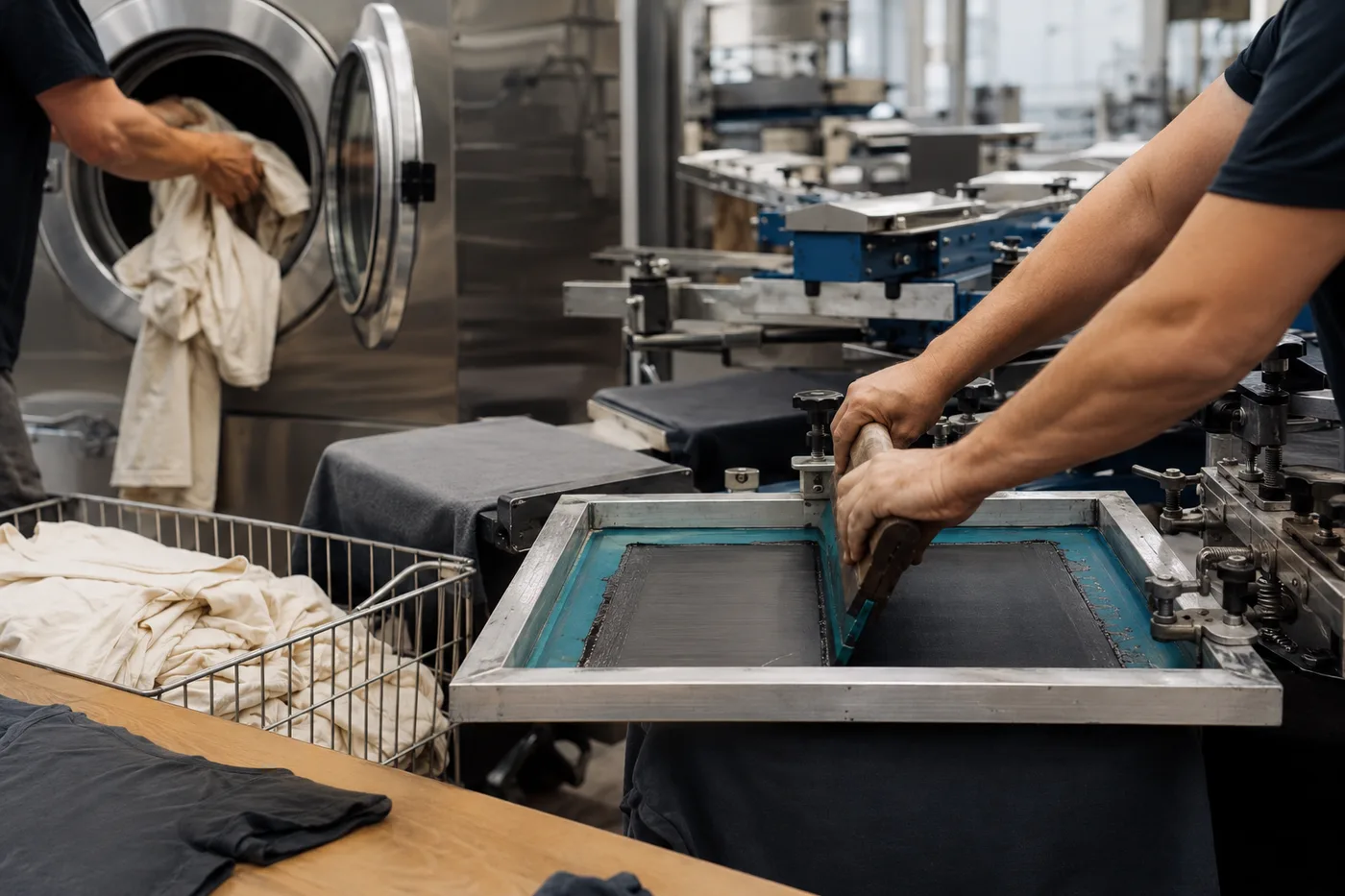
Sleeve print t-shirt manufacturer means a factory that prints logos, text or graphics on tee sleeves, either on cut panels before sewing or on finished shirts. Typical sleeve prints are 5-10 cm wide on short sleeves and up to 40-55 cm long on long sleeves, with strike-offs in 5-10 days. MOQ depends on style and fabric.
Sleeve print t-shirt manufacturer means a factory that prints logos, text or graphics on tee sleeves, either on cut panels before sewing or on finished shirts. Typical sleeve prints are 5-10 cm wide on short sleeves and up to 40-55 cm long on long sleeves, with strike-offs in 5-10 days. MOQ depends on style and fabric.
Sleeve prints are one of the easiest ways to make a tee look more branded without crowding the chest or back. A small logo on the upper sleeve, a vertical word running down a long sleeve, or a tour list along the arm all add detail that customers notice in photos and on the street. Sleeve printing is also more technical than it looks. Sleeves are narrow, curved and graded differently from the body, so a print that sits perfectly on a medium can look too low on a small or wrap around the seam on an extra large. This guide explains how a sleeve print t-shirt manufacturer handles those details.
What is a sleeve print t-shirt manufacturer?
A sleeve print t-shirt manufacturer is a factory that produces tees with decoration on one or both sleeves, choosing whether to print flat sleeve panels before assembly or the finished garment on a sleeve platen, and controlling placement height, print size and alignment across sizes. Short sleeve prints are usually 5-10 cm wide, long sleeve prints run 40-55 cm, and strike-offs take 5-10 days.
Should sleeves be printed before or after sewing?
There are two main routes. In panel printing, the factory prints the cut sleeve pieces flat before the tee is sewn. This gives very accurate placement, allows prints close to the hem or running the full sleeve length, and suits large runs. The downside is that printed panels must be tracked carefully through sewing, and a misprinted panel means recutting.
In garment printing, the finished tee is loaded onto a sleeve platen and printed. This is flexible, works well for small logos and short runs, and lets you decorate blank stock. It is harder to print close to seams or across the full length of a long sleeve, because the curve of the sleeve and the seam get in the way. Ask your factory which route it recommends for your artwork size and quantity.
Adding sleeve graphics to your tees? Weavnora screen prints heavyweight tees and can strike off your sleeve artwork on your fabric and colour, so you can check size, height and wrap before bulk. See our screen printing page for the base styles and fabrics we work with, then request a quote with your style, fabric and quantities. MOQ depends on style and fabric, so we confirm it in your quote.
How do sleeve print sizes and placement work?
On short sleeve tees, most sleeve prints are small logos or short words placed a few centimetres below the shoulder seam or above the hem. On oversized tees with a dropped shoulder, the shoulder seam sits lower on the arm, so the print may need to move up the sleeve to stay visible. Our guide on how to RFQ sleeve print placement height explains how to write the measurement in your brief.
Long sleeve tees allow vertical graphics along the outer arm. Here the main risk is wrap, where the print curls round the arm or drifts towards the underarm seam. The sleeve print wrap tolerance guide for oversized tees covers how buyers set limits for that. For long sleeve blanks and builds, see the long sleeve heavyweight tee manufacturer guide.
Screen print vs embroidery vs heat transfer on sleeves: which option fits?
| Selection criteria | Screen print | Embroidery | Heat transfer |
|---|---|---|---|
| Best use | Logos, text, long vertical graphics | Small premium logos | Names, numbers, multi-colour small art |
| Detail | Good, depends on mesh | Limited by stitch size | High for small art |
| Handfeel | Soft to medium | Raised, firmer | Smooth film |
| Long sleeve length prints | Yes, often panel printed | Rare, slow | Possible in sections |
| Set-up | Screens and strike-off | Digitising and sew-out | Transfer production |
The trade-offs are set-up cost, handfeel and durability. Screen printing is usually the most efficient choice for repeating sleeve graphics in bulk and gives a soft result with water-based or discharge inks. Embroidery looks premium on a small upper-sleeve logo but adds weight and can pucker on lighter jersey. Heat transfers suit personalised names or very detailed small artwork. If your design also includes a large back graphic, the back print t-shirt manufacturer guide covers big placements.
How do you keep sleeve prints consistent across sizes?
Sleeves change length and width between sizes, so a fixed print position does not always work. Decide whether the print should stay the same distance from the shoulder seam on every size or scale with the sleeve. For short sleeves, a fixed distance usually looks best. For long vertical prints, many brands use two print sizes, one for smaller sizes and one for larger sizes, so the graphic never runs into the cuff.
Send the factory a placement chart with measurements for each size, artwork in vector format with exact widths, and colour references. Ask for a size set strike-off before bulk so you can check placement on the smallest and largest sizes as well as the medium. The screen printed t-shirt manufacturer guide explains general print set-up on tees.
Which quality checks matter for sleeve prints?
Inspectors should check that left and right sleeve prints sit at the same height when both sleeves are printed, that prints are straight relative to the sleeve fold, and that there is no ghosting or smudging near seams. They should measure placement on samples from every size and run a wash test on printed tees to check cracking or fading. On long sleeves, they should lay the garment flat and confirm the print has not twisted with the sleeve after washing. The custom t-shirt manufacturing guide covers the full tee process.
Which inks suit sleeve prints?
Sleeves bend and stretch more than the chest, so ink choice matters. Water-based and discharge inks soak into cotton jersey and stay soft, which suits small logos and long vertical text on heavyweight tees. Plastisol gives bright, opaque colour on dark sleeves and is easy to control, but a thick deposit can feel heavy on a narrow sleeve. Puff or high density effects can work on short sleeve logos, but they should be tested for cracking at the elbow on long sleeves. Ask the factory to strike off the same ink on the same fabric colour you plan to order.
How long does a sleeve print order take?
Allow time for blanks or cut panels, artwork separation, screens, a strike-off on your fabric, any placement adjustment and bulk printing. Panel printing adds a step before sewing, so confirm the sequence early. Orders with sleeve, chest and back prints take longer because each placement needs its own set-up and inspection.
Sleeve print t-shirt manufacturer: typical specs and key numbers
| Spec | Typical estimate range |
|---|---|
| Tee jersey weight | 200-320 GSM |
| Short sleeve print width | 5-10 cm |
| Long sleeve vertical print length | 40-55 cm |
| Distance below shoulder seam | 3-8 cm |
| Strike-off time | 5-10 days |
| Bulk printing after approval | 7-15 days |
| MOQ (pcs per style and colour) | Depends on style and fabric; confirmed in your quote |
These are typical industry estimate ranges for planning, not quotes; confirm actual figures with your supplier for your fabric, quantity and destination.
Key takeaways
- A sleeve print t-shirt manufacturer chooses between panel printing and garment printing for each design.
- Dropped shoulders move the visible sleeve area, so placement must suit the block.
- Screen print is usually most efficient for repeat sleeve graphics; embroidery suits small premium logos.
- Use a size-by-size placement chart and a size set strike-off.
- Check left and right print height, twist and wash durability during bulk.
Request a sleeve print t-shirt quote
Want sleeve graphics that line up on every size? Send your tech pack or reference images, fabric preference, colours and quantities through our quote request form. MOQ depends on style and fabric, so we confirm it in your quote together with sampling time, approval steps and an itemised price.
Buyer questions
Frequently asked questions
Can you print on both sleeves?
Yes. Each sleeve is a separate placement, so it is set up and checked on its own.
Is it better to print sleeves before sewing?
Panel printing is more accurate for long or near-seam prints; garment printing suits small logos.
Can sleeve prints run the full length of a long sleeve?
Yes, usually by panel printing so the graphic stays straight.
Do sleeve prints crack?
Well-cured prints with the right ink stay flexible; we wash-test strike-offs before bulk.
What is the MOQ for sleeve print tees?
MOQ depends on style and fabric, so we confirm it in your quote.
Start a sourcing conversation
Share quantity, target GSM, destination and sample requirements.
Start your RFQ →Email files to postmaster@weavnora.com.