blog · B2B PROCUREMENT
Screen Printing Setup Cost: Screens, Colours and Volume
By Weavnora · Updated
Direct answer
What buyers need to know
Screen printing setup cost covers screens, films, mixing and press setup for each colour and placement, charged once per design. A 1-4 colour front print needs 1-4 screens, plus an underbase on dark garments, with strike-offs in 5-10 days; setup per piece falls sharply as quantity rises. MOQ depends on style and fabric, so confirm it in your quote.
Screen printing setup cost covers screens, films, mixing and press setup for each colour and placement, charged once per design. A 1-4 colour front print needs 1-4 screens, plus an underbase on dark garments, with strike-offs in 5-10 days; setup per piece falls sharply as quantity rises. MOQ depends on style and fabric, so confirm it in your quote.
Screen printing quotes often surprise first-time buyers. The price per piece looks reasonable, then a "screen charge" or "setup fee" appears on top. That line is not a hidden cost. It reflects real work that happens before the first shirt is printed, and it explains why screen printing gets cheaper per piece as quantity grows. This guide breaks setup cost into its parts and shows how to plan designs so setup stays under control.
What is screen printing setup cost?
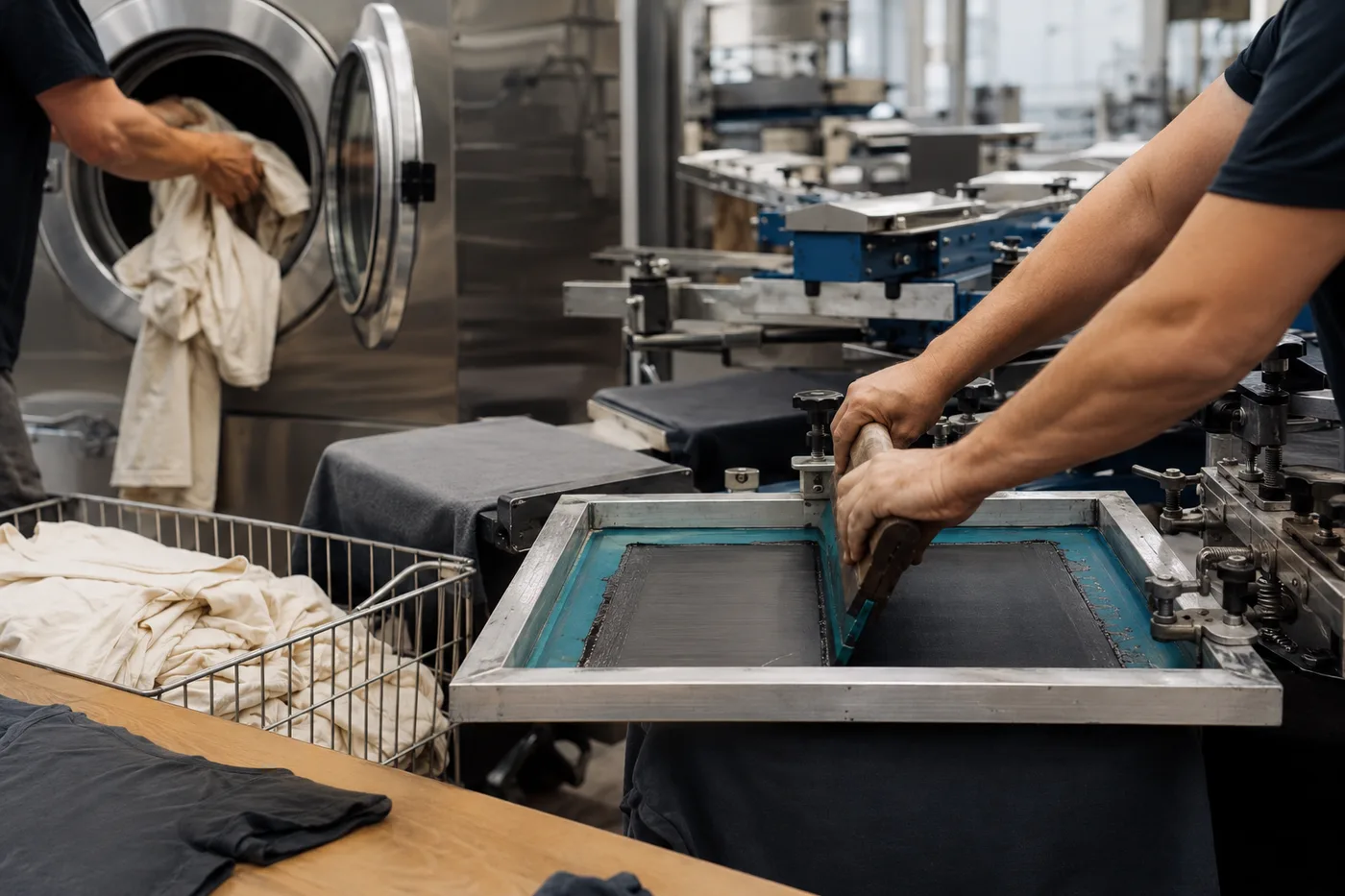
Screen printing setup cost is the one-time charge for preparing a design for printing, including making one screen per colour, outputting films, mixing ink to your colour references, registering screens on the press and printing test pieces. It is charged per design and placement, not per garment. As a typical industry estimate, a design with 1-4 colours needs 1-4 screens, plus one extra underbase screen on dark garments.
What does screen printing setup include?
Setup usually covers these steps:
- Artwork separation: the design is split into one layer per colour, and halftones are created for gradients.
- Film output: each colour layer is printed as a film positive.
- Screen preparation: a mesh screen is coated with emulsion, exposed with the film and washed out to create the stencil. One screen per colour.
- Ink mixing: inks are mixed to match your Pantone or physical references.
- Press setup and registration: screens are mounted and aligned so colours land exactly where they should.
- Test prints and strike-off: first pieces are printed and checked against the approved artwork. As a typical industry estimate, a strike-off takes about 5-10 days from approved artwork.
Some suppliers bundle these into one setup fee; others list screens, colour matching and strike-offs separately. Our article on screen print mesh count approval explains why mesh choice is part of setup.
Want a clear print quote? Weavnora quotes screen setup as a separate line from print cost per piece, so you can see how quantity changes your price. See our screen printing page for the base styles and fabrics we work with, then request a quote with your style, fabric and quantities. MOQ depends on style and fabric, so we confirm it in your quote.
Why is setup charged per colour?
Each colour needs its own screen and its own registration on the press. A four-colour design takes about four times the screen work of a one-colour design. On dark garments, printers often add a white underbase screen so colours stay bright, which adds one more screen. Special effects such as puff or high density need their own screens and sometimes thicker stencils. Our puff print cost per piece guide shows how specialty inks add to both setup and per-piece cost.
How does setup spread across quantity?
Setup is a fixed cost, so it weighs heavily on small orders and almost disappears on large ones. As an illustration with simple numbers: if setup for a design equals the print price of 50 pcs, then on a 100 pcs order setup adds about 50% to the print cost per piece, while on a 1,000 pcs order it adds about 5%. Across typical runs of about 100-1,000 pcs, the setup share can therefore move from roughly 50% to 5-10% of print cost, as an illustration rather than a quote. These figures only show the principle; real ratios depend on your design and supplier.
This is why many brands limit colours on small first runs and add colours once a design proves itself. It is also why screen printing becomes the cheapest method at volume, as our comparison of screen print vs DTG cost per shirt shows.
Which factors raise or lower setup cost?
- Number of colours: the biggest driver.
- Number of placements: front, back and sleeve prints each need their own screens.
- Garment colour: dark garments usually need an underbase.
- Artwork complexity: fine halftones need finer mesh and more careful exposure.
- Print size: very large prints, for example 35-40 cm wide back prints, may need oversized screens.
- Colour matching: exact Pantone matching may add a charge.
- Size-specific prints: if the print scales by size, separate screens may be needed for small and large sizes.
Do you pay setup again on reorders?
Often not in full. Many printers keep screens or films for a period, so a repeat order of the same design and colours may only need press setup. Policies vary: some reclaim screens after a few months to reuse the mesh. Ask how long screens are stored and what a reorder setup costs. As a typical industry estimate, storage periods of about 3-12 months are common, but this is not a promise from any supplier. Keeping the same colours and placement makes reorders cheaper.
Screen printing vs DTG vs DTF setup: what are the trade-offs?
| Selection criteria | Screen printing | DTG | DTF transfer |
|---|---|---|---|
| Setup per design | Screens per colour | Very low | Low, film printing |
| Cost per piece at small runs | High because of setup | Medium | Medium |
| Cost per piece at large runs | Lowest | Stays similar | Stays similar |
| Colour matching | Exact spot colours | Approximate | Approximate |
| Many design variations | Costly | Efficient | Efficient |
| Best for | Repeated designs in volume | Small runs, complex art | Small runs, mixed fabrics |
The trade-offs are upfront cost versus per-piece cost. Screen printing has the highest setup but the lowest cost per piece at volume and the best colour control. DTG and DTF have little setup but a cost per piece that falls only slightly with volume. For a broader comparison, see our guide to DTF vs screen printing for clothing brands.
How can you reduce screen printing setup cost?
- Simplify artwork to fewer colours, or use one-colour designs on several garment colours.
- Use the same print size across sizes when the design allows.
- Group several designs in one order to share press time and strike-offs.
- Keep proven designs unchanged for reorders so screens can be reused.
- Ask whether a tonal or one-colour version of your logo would work on light garments.
How should you compare setup costs between suppliers?
Ask each supplier to break the quote into setup, print cost per piece, strike-off or sample charges and any colour matching. Check whether the underbase is counted as a colour, how many placements are included and whether test prints are washed. A low setup fee combined with a high per-piece price may cost more overall than the reverse. Our apparel manufacturing cost and pricing guide explains how decoration sits inside your full landed cost.
Screen printing setup cost: typical specs and key numbers
| Spec | Typical estimate range |
|---|---|
| Screens for a typical front print | 1-4 screens, plus underbase on dark garments |
| Placements commonly quoted | 1-3 placements |
| Strike-off rounds before approval | 1-2 rounds |
| Strike-off lead time | 5-10 days |
| Setup share at small vs large runs | 5-50% of print cost, illustrative only |
| Screen storage for reorders | 3-12 months, varies by supplier |
| MOQ (pcs per style and colour) | Depends on style and fabric; confirmed in your quote |
These are typical industry estimate ranges for planning, not quotes; confirm actual figures with your supplier for your fabric, quantity and destination.
Key takeaways
- Setup covers separations, films, screens, ink mixing, registration and test prints.
- It is charged per colour and placement, and dark garments usually add an underbase screen.
- Setup is a fixed cost, so it matters most on small orders and fades on large ones.
- Reorders of unchanged designs often need only press setup if screens are stored.
- Compare quotes on setup, per-piece print cost and sample charges together.
Request a screen printing setup cost quote
Ready to price a screen printed order? Send your tech pack or reference images, fabric preference, colours and quantities through our quote request form. MOQ depends on style and fabric, so we confirm it in your quote together with sampling time, approval steps and an itemised price.
Buyer questions
Frequently asked questions
What is a screen setup fee?
It is the one-time charge for preparing screens, films, inks and press registration for a design before bulk printing starts.
Why is screen printing setup charged per colour?
Each colour needs its own screen and its own alignment on the press, so more colours mean more preparation work.
Do I pay screen setup again for a reorder?
Often only partly. If the printer stores your screens and the design is unchanged, a reorder may only need press setup.
How can I lower screen printing setup cost?
Use fewer colours, keep the same print size across sizes and group designs in one order.
Is there an MOQ for screen printing?
MOQ depends on style and fabric. Send your artwork, colours and quantities through a quote request for an exact answer.
Start a sourcing conversation
Share quantity, target GSM, destination and sample requirements.
Start your RFQ →Email files to postmaster@weavnora.com.