blog · B2B PROCUREMENT
DTF vs Screen Printing for Clothing Brands: Run-Size Framework
By Weavnora · Updated
Direct answer
What buyers need to know
DTF vs screen printing for clothing brands is mostly a question of run size and artwork. DTF suits full-color designs and short runs of roughly 1–100 pcs with no screens, while screen printing usually wins from about 100–300+ pcs per design with 1–6 spot colors, softer handfeel options and proven wash durability.
DTF vs screen printing for clothing brands is mostly a question of run size and artwork. DTF suits full-color designs and short runs of roughly 1–100 pcs with no screens, while screen printing usually wins from about 100–300+ pcs per design with 1–6 spot colors, softer handfeel options and proven wash durability.
Brands now have more print options than ever. Screen printing remains the workhorse for apparel, while direct-to-film (DTF) transfers have spread quickly because they handle full-color art and short runs without screens. This guide compares the two methods and gives a run-size framework to choose per design, not per brand. It does not quote prices; ask your supplier for itemized quotes based on your artwork and quantities.
How does each method work?
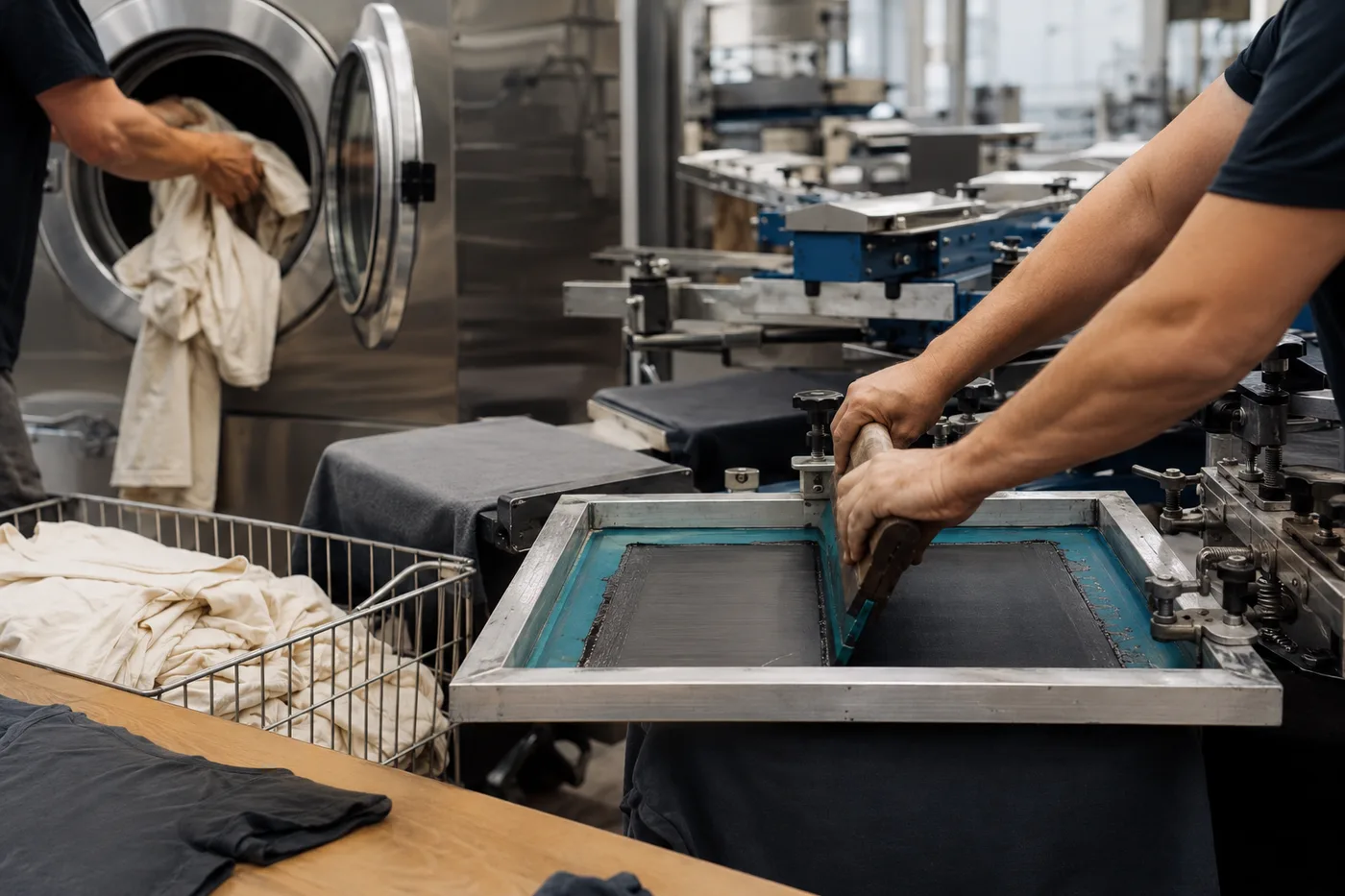
Screen printing
- Artwork is separated into spot colors.
- A mesh screen is made for each color.
- Ink is pushed through each screen onto the garment, layer by layer.
- The print is cured with heat.
Inks include plastisol (bright, opaque), water-based (soft) and discharge (removes dye from cotton for a very soft print). Specialty options include puff, high-density, metallic and more.
DTF (direct-to-film)
- The design is printed onto PET film with CMYK pigment inks plus a white layer.
- Hot-melt adhesive powder is applied to the wet ink.
- The film is cured, creating a ready-to-press transfer.
- The transfer is heat-pressed onto the garment and the film is peeled.
DTF vs screen printing: comparison table
| Factor | DTF | Screen printing |
|---|---|---|
| Setup | No screens; artwork file to print | One screen per color |
| Color detail | Full color, gradients, photos | Best with spot colors; halftones possible |
| Run size | Efficient for short runs | Efficient for larger runs |
| Handfeel | Thin film layer | Soft to heavy, depending on ink |
| Breathability | Lower on large solid areas | High with water-based or discharge |
| Fabric range | Cotton, polyester, blends | Wide, but polyester needs low-bleed inks |
| Durability | Good when well made; varies by supplier | Proven when cured correctly |
| Special effects | Limited (some glitter or glow films) | Puff, high-density, discharge, metallic |
| Placement flexibility | Easy on awkward areas such as sleeves | Needs suitable platens and setup |
Run-size framework: which method for which design?
Use these four questions for each design.
1. How many pieces per design?
- Very small runs or many designs with a few pieces each: DTF usually avoids setup costs.
- Larger runs per design: screen printing usually spreads setup over enough pieces to be efficient.
2. How many colors and how much detail?
- Photographic or full-color artwork with gradients: DTF, or DTG on cotton.
- One to a few spot colors: screen printing.
3. What should the print feel like?
- Soft, breathable, vintage look: water-based or discharge screen printing.
- Crisp, vivid edges and small text: either method, depending on run size.
- Large solid areas on a premium tee: screen printing, to avoid a heavy film patch.
4. How will the garment be used?
- Heavy-use garments, uniforms or many washes: screen printing has the longer track record; test DTF suppliers carefully.
- Short-lived event or test-drop items: DTF is often fine.
Brands often combine methods: screen printing for core designs and large runs, DTF for test drops, personalization and full-color graphics.
How should you test durability?
Whatever you choose, test before bulk:
- Wash samples several times per your care label instructions and check cracking, fading and edge lift.
- Stretch the print to check cracking, especially on rib or stretchy fabrics.
- Check rubbing on dark garments.
- For DTF, check edges after washing; poor adhesion often appears there first.
Our special print options guide covers durability considerations for specialty techniques.
Planning specialty-print tees or hoodies? Send your tech pack or reference photos, target fabric weight and quantities through our quote request form, and see what we produce on the special printing page.
What about DTG, the third option?
Direct-to-garment (DTG) prints ink directly into the fabric, giving a soft feel on cotton for full-color designs. It competes with DTF for short-run full-color work on cotton, but is less suited to polyester. Our screen print vs DTG cost per shirt guide and DTG vs screen print for heavyweight cotton tees cover that comparison.
How do the economics work without exact prices?
Think of cost per design as setup + (unit print cost × quantity):
- Screen printing has higher setup (screens, registration) and lower unit print cost at volume.
- DTF has low setup and a unit cost tied mainly to print area and film.
Plot both for your actual quantities and artwork with quotes from your supplier. The crossover point depends on colors, print size and supplier, so do not rely on a generic rule.
What should you ask your print supplier?
- Which methods do you run in house, and which are outsourced?
- Which inks or films do you use, and what wash results have you seen?
- How do you handle polyester and blends to avoid dye migration?
- What are setup fees and minimums per design for each method?
- Can you produce strike-offs or samples on the final garment before bulk?
Which method suits which product type?
- Premium heavyweight tees: screen printing, often water-based or discharge, for a soft hand that matches the fabric quality.
- Hoodies and crewnecks: screen printing for large graphics; DTF for small full-color badges or sleeve hits.
- Performance and polyester pieces: DTF is flexible here because it bonds to synthetics without dye-bleed issues common with some screen inks.
- Personalized items: names and numbers for teams or staff are easier with DTF or other transfers, since each piece differs.
- Event and test drops: DTF lets you launch many designs in small quantities and reprint the winners by screen later.
What are common DTF quality issues?
DTF quality depends heavily on the producer. Watch for:
- Edge lifting after washing, often from insufficient pressure, temperature or dwell time.
- Cracking on stretchy fabrics when the film is too thick or the adhesive too rigid.
- Shiny or plasticky surfaces on large solid areas, which can look cheap on premium garments.
- Powder residue around the design if excess adhesive is not removed before curing.
- Inconsistent color between batches when printer profiles or inks change.
Ask for wash test results and inspect pressed samples closely, especially at edges and fine lines.
DTF vs screen printing for clothing brands: typical specs and key numbers
| Spec | Typical estimate range |
|---|---|
| DTF sweet spot per design | roughly 1–100 pcs |
| Screen printing sweet spot per design | roughly 100–300+ pcs |
| Screen print colors per design commonly used | 1–6 spot colors |
| Screen setup per color | one screen per color, 1–2 days prep |
| DTF heat press settings (typical guidance) | about 150–165 °C for 10–15 seconds, per film supplier |
| Wash testing before bulk approval | 3–5 home wash cycles minimum |
| Large print area on adult tees | about 25–35 cm wide |
| Typical screen print MOQ per design and color | 50–300 pcs |
| Common tee fabric weight printed | 180–300 GSM |
These are typical industry estimate ranges for planning, not quotes; confirm actual figures with your supplier for your fabric, quantity and destination.
Key takeaways
- DTF suits short runs, full-color art, many designs and mixed fabrics.
- Screen printing suits larger runs with spot colors, soft-hand inks and special effects.
- Decide per design using run size, colors, handfeel and garment use.
- Test wash and stretch durability before bulk for either method.
- Compare setup plus unit cost at your real quantities rather than generic rules.
Choose the right print method for each design
Weavnora offers screen printing, DTG and special prints on heavyweight tees and hoodies and can advise when a transfer method fits better. See our screen printing and special printing capabilities, then contact us with your artwork and quantities.
Have a tech pack ready? Upload it through our quote request form for a costed reply on specialty-print tees or hoodies. Our special printing page shows what we make.
Buyer questions
Frequently asked questions
What is DTF printing?
Direct-to-film printing prints a design onto a PET film with pigment inks and a white layer, applies adhesive powder, cures it and heat-presses it onto the garment.
Is DTF as durable as screen printing?
Well-produced DTF can wash well, but quality varies with film, ink, powder and pressing; screen printing has a longer track record for heavy-use garments.
Which method feels softer?
Water-based or discharge screen prints usually feel softest; DTF leaves a thin film layer, which is more noticeable on large designs.
When does screen printing become more economical?
As quantities per design rise, screen setup is spread over more pieces, so screen printing usually becomes more economical for larger runs with limited colors.
Can DTF print on polyester and blends?
Yes. DTF works on cotton, polyester and blends, which makes it flexible for mixed fabric programs.
Start a sourcing conversation
Share quantity, target GSM, destination and sample requirements.
Start your RFQ →Email files to postmaster@weavnora.com.