blog · B2B PROCUREMENT
Hoodie Printing Cost per Piece: What Drives the Price
By Weavnora · Updated
Direct answer
What buyers need to know
Hoodie printing cost per piece depends on print method, colours, print size, placements, set-up and order volume, with specialty inks adding more. As a typical estimate, a 25-30 cm one-colour front print costs far less than a multi-colour back print, and set-up spreads over the run. MOQ depends on style and fabric.
Hoodie printing cost per piece depends on print method, colours, print size, placements, set-up and order volume, with specialty inks adding more. As a typical estimate, a 25-30 cm one-colour front print costs far less than a multi-colour back print, and set-up spreads over the run. MOQ depends on style and fabric.
The print is often the most visible part of a hoodie, and it can also be one of the biggest cost lines after fabric. Two hoodies on the same blank can differ a lot in price because of the print method, the number of colours, the size of the graphic and how many places it goes. Understanding the drivers lets you design artwork that looks strong and fits your budget. This guide explains hoodie printing cost per piece without quoting prices, because the numbers change with quantity, artwork and timing, and shows where you can save.
What is hoodie printing cost per piece?
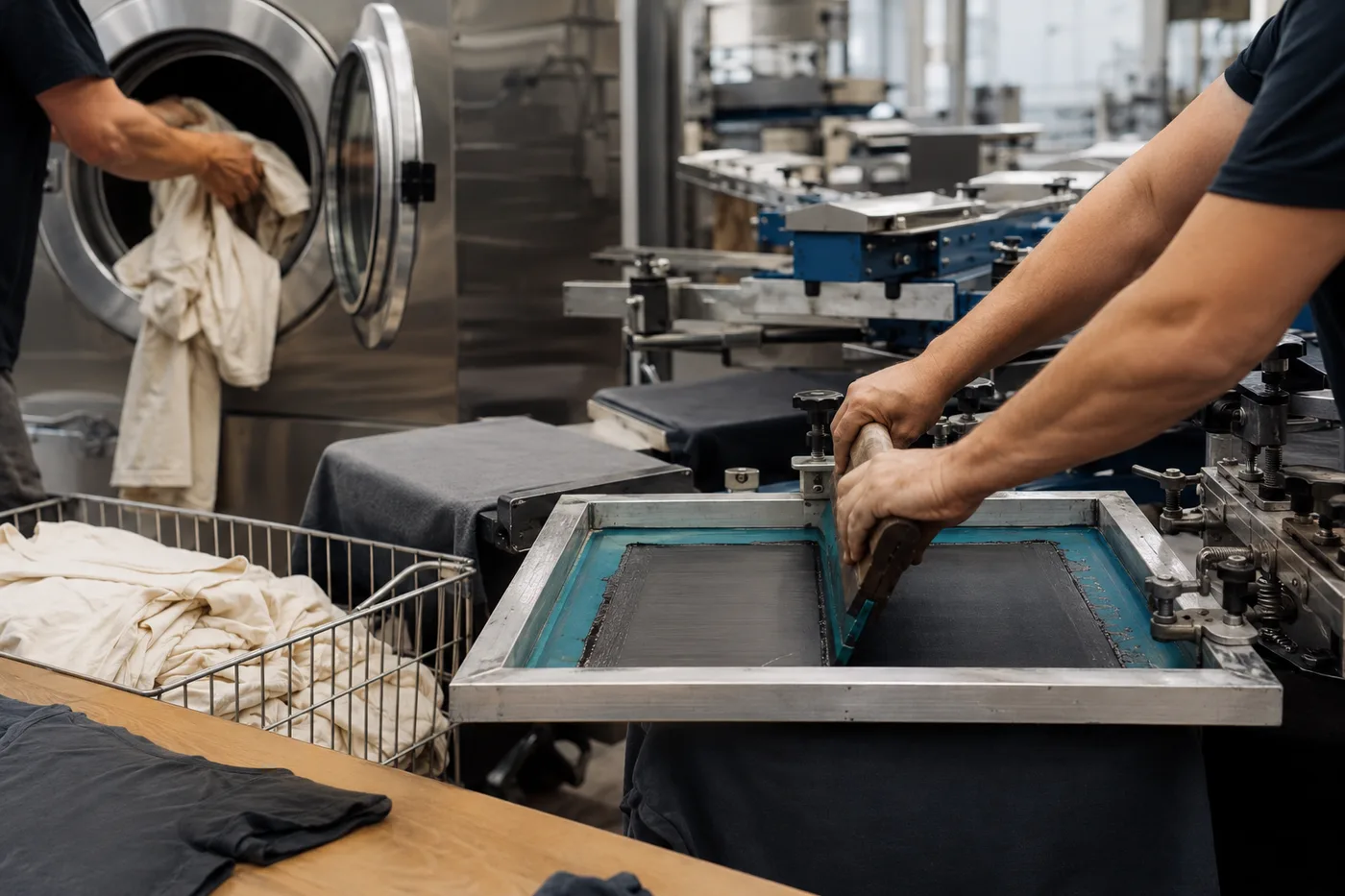
Hoodie printing cost per piece is the decoration cost added to each hoodie for applying a print, separate from the blank garment. It bundles screens or film, ink, labour, curing and a share of set-up spread across the order. A one-colour 25-30 cm chest print costs far less than a 6-colour back print plus 2 sleeve prints. As a typical industry estimate, set-up is fixed, so doubling the quantity lowers the per-piece cost of screen printing much more than DTF.
What drives hoodie printing cost per piece?
- Print method. Screen print, DTF, DTG, heat transfer and specialty inks have different set-up and run costs.
- Number of colours. In screen printing each colour needs its own screen and pass.
- Print size. Larger prints use more ink or film and take longer.
- Number of placements. Each placement is a separate set-up and handling step.
- Fabric colour. Dark hoodies often need a white underbase, adding a screen and a pass.
- Specialty effects. Puff, high density, crackle, foil, glitter and reflective add materials and time.
- Order volume. Fixed set-up is spread across the run, so per-piece cost drops with quantity.
The apparel manufacturing cost and pricing guide explains how decoration fits into the full garment cost.
Want a clear print cost breakdown? Weavnora makes heavyweight hoodies and itemises fabric, making and each print or embroidery placement in your quote, so you can see what drives the price. See our heavyweight hoodies page for the base styles and fabrics we work with, then request a quote with your style, fabric and quantities. MOQ depends on style and fabric, so we confirm it in your quote.
How do print methods compare?
| Selection criteria | Screen print | DTF | DTG |
|---|---|---|---|
| Set-up cost | High, screens per colour | Low | Very low |
| Cost per piece at low volume | High | Low to medium | Medium |
| Cost per piece at high volume | Lowest | Medium | Medium to high |
| Colours | Each colour adds cost | Full colour, no extra | Full colour, no extra |
| Hand feel | Varies by ink | Film layer | Soft on light colours |
| Durability on fleece | Very high | High | Medium |
Screen print vs DTF on hoodies: which option fits?
The trade-offs are set-up against unit cost. Screen print has a fixed cost per colour, so it becomes the cheapest per piece on larger runs with few colours, and it gives the most durable, best-looking print on fleece. DTF has almost no set-up and prints full colour at the same cost, so it wins on small runs, many designs or photographic art, but the film feels heavier on large areas. Our screen printing setup cost guide explains the set-up side, and our DTF printing cost per shirt guide covers DTF pricing logic.
How does print size change the cost?
Screen sizes and platen sizes set practical limits. A left chest logo of about 8-10 cm is the cheapest placement. A standard front print of 25-30 cm uses a normal screen. An oversized print of 35-40 cm or more may need a jumbo screen and slower printing. For DTF, cost scales with the film area, so a large back print costs several times a chest logo. Keep oversized prints for hero styles.
How do placements add up?
Each placement adds set-up, loading and curing. A common hoodie layout might include a front chest print, a large back print, one sleeve print and a hood print. Each one adds its own cost, and hood and sleeve prints are slower to load. Consider which placements really sell the design. Often a strong back print plus a small chest logo gives most of the impact for much less cost than four placements.
How do specialty inks change the cost?
- Puff ink. Extra ink and heat; see our puff print cost per piece guide.
- High density. Thick stencils and multiple passes.
- Crackle and glitter. Specialty inks and slower curing.
- Foil. A print plus a separate foil press step.
- Discharge and water based. Soft hand, with stricter curing.
Specialty effects are best used on one element of the design, not the whole print.
Print vs embroidery on hoodies: when does each make sense?
Embroidery is priced by stitch count, not colours. A small embroidered chest logo can be close to a print in cost, while a large embroidered back design costs much more than a print. Many brands mix: embroidered chest logo, printed back graphic. Our hoodie embroidery cost guide explains stitch-based pricing.
Where can brands save on hoodie printing?
- Reduce screen colours; use the hoodie colour as part of the design.
- Keep the same artwork across colours to reuse screens.
- Group designs into fewer, larger runs.
- Use DTF for small test runs and switch to screen print when a design sells.
- Limit specialty inks to a key element.
- Avoid placements that are slow to load, such as the hood, unless they matter to the design.
How does printing fit into the full hoodie cost?
Printing is one line alongside fabric, trims, sewing, washing, labels, packing and shipping. Our pillar guide on how much it costs to manufacture a hoodie shows how the parts fit together. Ask your manufacturer to itemise each placement in the quote, so you can compare options and decide which ones to keep.
What should you send to get an accurate print quote?
- Vector artwork for each placement, with sizes in cm.
- Number of colours and any Pantone references.
- Hoodie colour and fabric.
- Any specialty effects.
- Quantities per design, colour and size.
Hoodie printing cost per piece: typical specs and key numbers
| Spec | Typical estimate range |
|---|---|
| Left chest print width | 8-10 cm |
| Standard front or back print width | 25-30 cm |
| Oversized print width | 35-40 cm |
| Screen print colours per design | 1-8 colours |
| Print sample lead time | 7-12 days |
| Hoodie fleece weight | 300-450 GSM |
| MOQ (pcs per style and colour) | Depends on style and fabric; confirmed in your quote |
These are typical industry estimate ranges for planning, not quotes; confirm actual figures with your supplier for your fabric, quantity and destination.
Key takeaways
- Hoodie printing cost per piece depends on method, colours, size, placements, specialty inks and volume.
- Screen print is cheapest per piece on larger runs with few colours.
- DTF suits small runs, many designs and full colour art.
- Each extra placement and specialty effect adds cost.
- Ask for each print placement to be itemised in the quote.
Request a hoodie printing cost per piece quote
Ready to price your printed hoodies? Send your tech pack or reference images, fabric preference, colours and quantities through our quote request form. MOQ depends on style and fabric, so we confirm it in your quote together with sampling time, approval steps and an itemised price.
Buyer questions
Frequently asked questions
What is hoodie printing cost per piece?
It is the decoration cost added to each hoodie for the print, covering screens or film, ink, labour, curing and a share of set-up.
Is screen print or DTF cheaper for hoodies?
Screen print is usually cheaper per piece on larger runs with few colours; DTF is often cheaper on small runs and full colour art.
Does a bigger print cost more?
Yes. Larger prints use more ink or film and may need bigger screens and slower printing.
How can I lower hoodie printing cost?
Use fewer colours, fewer placements, shared artwork and specialty inks only on key elements.
What is the MOQ for printed hoodies?
MOQ depends on style, fabric and print. Send artwork and quantities through a quote request.
Start a sourcing conversation
Share quantity, target GSM, destination and sample requirements.
Start your RFQ →Email files to postmaster@weavnora.com.