oem-odm · B2B PROCUREMENT
Gradient Print T-Shirt Manufacturer: Halftone and Fade Guide
By Weavnora · Updated
Direct answer
What buyers need to know
Gradient print t-shirt manufacturer means a factory that prints smooth colour fades on tees using halftone screen printing, split-fountain blends or digital printing. Typical programs use 180-300 GSM cotton jersey, 45-65 lpi halftones, 7-12 days for print strike-offs and 25-40 days for bulk after approval. MOQ depends on style and fabric.
Gradient print t-shirt manufacturer means a factory that prints smooth colour fades on tees using halftone screen printing, split-fountain blends or digital printing. Typical programs use 180-300 GSM cotton jersey, 45-65 lpi halftones, 7-12 days for print strike-offs and 25-40 days for bulk after approval. MOQ depends on style and fabric.
Gradients are everywhere in graphic tees: sunset fades on surf and travel shirts, chrome-style blends on streetwear, and soft colour washes behind band logos. On a screen they look effortless, but on knitted cotton a gradient is one of the hardest effects to reproduce. Ink spreads into the fibres, small dots disappear, and a fade that looks smooth on proof can turn into visible steps or a hard edge on the shirt. A gradient print t-shirt manufacturer that understands halftones, mesh, ink and fabric texture will tell you early which method suits your artwork and how to prepare files so the fade survives printing and washing.
What is a gradient print t-shirt manufacturer?
A gradient print t-shirt manufacturer is a garment factory that produces tees decorated with artwork that fades smoothly from one colour to another or from solid ink to the bare shirt. The fade is built with halftone dots in screen printing, a split-fountain ink blend on one screen, or digital printing. Most programs print on 180-300 GSM cotton jersey with halftones of 45-65 lines per inch.
Which methods can print a gradient on a tee?
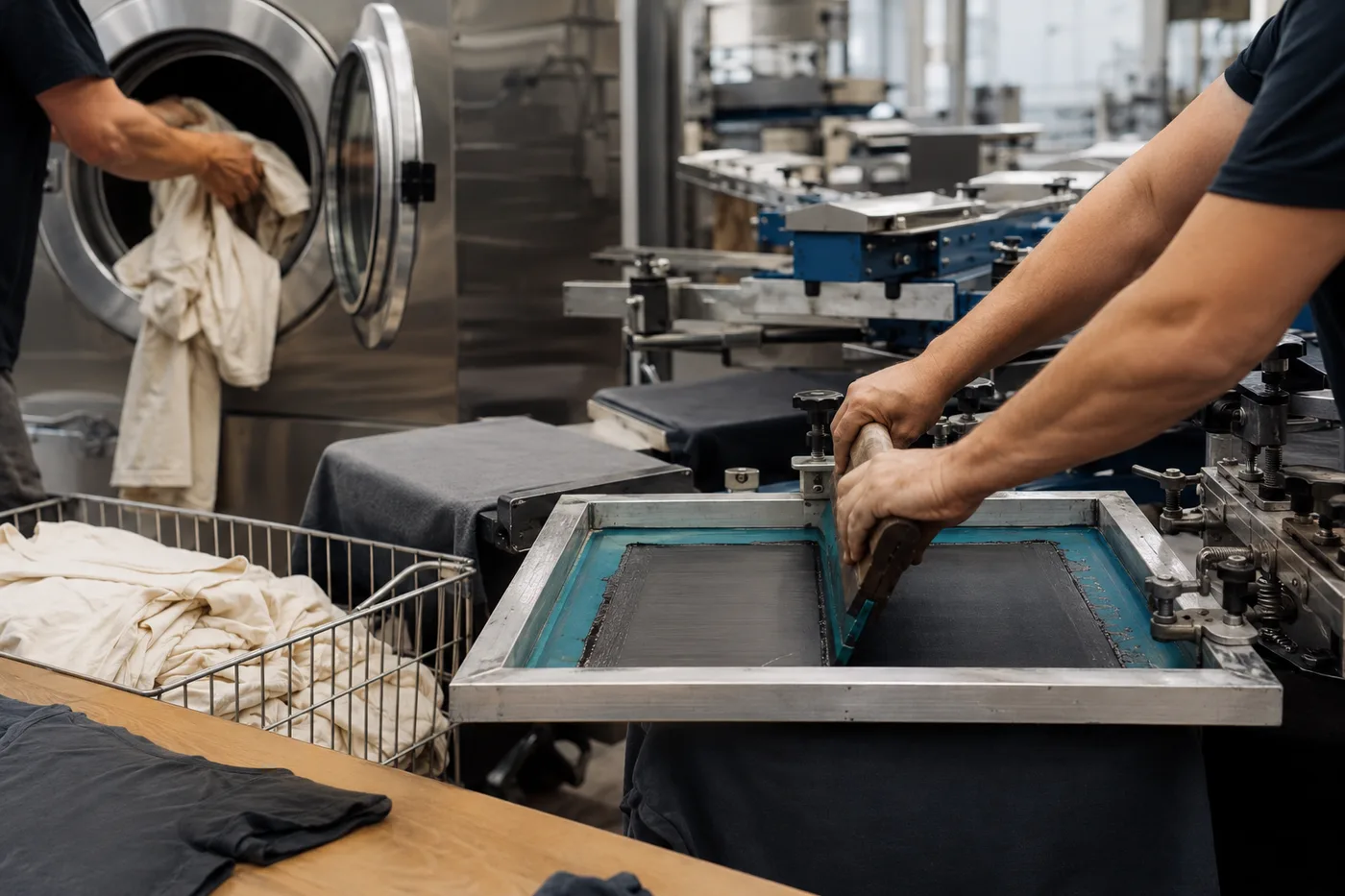
The most common method is halftone screen printing. The artwork is converted into dots of varying size; large dots read as solid colour and small dots let the shirt show through, so the eye sees a fade. It suits large runs and gives a crisp vintage look. The second method is a split-fountain or blend print, where two or more inks are placed side by side on one screen and the squeegee blends them into a rainbow-style fade. It is fast and bold but less repeatable, because the blend zone drifts as the run progresses. The third method is digital printing, either direct to garment or direct to film transfer, which reproduces continuous tones with no dots at all. It suits small batches and photographic fades but feels different on the hand.
Many brands combine methods: a solid screen-printed logo on top of a digitally printed gradient background, or a halftone fade under a puff print outline. Our DTG vs screen print guide for heavyweight cotton tees compares the two main routes in more detail.
Planning a fade graphic for your tees? Weavnora prints heavyweight and washed tees with screen, digital and special print options and can strike off your gradient artwork on your chosen shirt colour before bulk. See our screen printing page for the base styles and fabrics we work with, then request a quote with your style, fabric and quantities. MOQ depends on style and fabric, so we confirm it in your quote.
Halftone vs split-fountain vs digital: which option fits?
| Selection criteria | Halftone screen print | Split-fountain blend | Digital (DTG or DTF) |
|---|---|---|---|
| Fade smoothness | Good, visible dots up close | Smooth but less controlled | Very smooth |
| Repeatability across bulk | High | Medium | High |
| Hand feel | Soft with water-based ink | Depends on ink | Soft (DTG) to film-like (DTF) |
| Best on dark shirts | Needs underbase | Needs underbase | Needs white layer |
| Setup effort | Screens per colour | One screen, careful ink placement | File prep only |
| Best for | Larger runs, vintage look | Rainbow and sunset fades | Small runs, photo fades |
The trade-offs are smoothness and repeatability against setup and hand feel. Halftones are the most reliable for bulk because each shirt receives the same dot pattern, but the dots are visible at close range and fine dots can close up on soft jersey. Split-fountain blends look striking and need only one screen, yet the blend line shifts from shirt to shirt, so buyers must accept natural variation. Digital printing gives the smoothest fades with no screen cost, but white underlayers on dark shirts can feel heavier and wash performance needs testing.
How should gradient artwork be prepared?
Send vector or high-resolution raster files at print size, at least 300 dpi, and tell the factory which colours must stay solid and which areas should fade. Avoid fades that end in very small dots below about 5% coverage, because those dots may not hold on the screen or may disappear into the fabric texture; it is better to end the fade cleanly. Ask the printer to set the halftone line count and angle for the shirt fabric, since a heavyweight open-end jersey shows texture differently from combed ring-spun cotton. Our artwork file handoff checklist covers the files and notes a factory needs.
How does the shirt colour and fabric affect the fade?
On white and light shirts, the shirt itself becomes the lightest step of the fade, so the gradient can be printed without an underbase. On black or dark shirts, a white underbase is usually needed, and the underbase must fade in step with the top colour or the edge will look cut off. Washed and garment-dyed tees have uneven tones, which can make a soft fade look patchy; test on a washed blank, or print after washing if the design allows. Heavier and denser fabrics usually hold fine dots better than loose, hairy jersey. The ink underbase opacity guide explains how to specify opacity.
How do you sample and approve a gradient print?
Ask for a strike-off on the actual shirt fabric and colour, not on paper or a different blank. Review it in daylight and under shop lighting, at arm's length and close up. Check whether the dots are even, whether the fade has visible steps, and whether the end of the fade is clean. Then wash the strike-off three to five times and check cracking, fading and dot loss. Approve one sample as the sealed standard so the bulk can be compared against it.
What should be checked in bulk?
Inspectors should compare pieces from the start, middle and end of the run with the sealed sample, because ink build-up and screen wear can change the fade during long runs. Check print placement, registration between colours, dot gain or loss, and the blend position on split-fountain prints. Check the cure with a stretch test on a few pieces per batch. For brands building a wider range, the custom t-shirt manufacturing guide shows how printing fits into development and bulk, and the tonal print t-shirt manufacturer guide covers subtle same-colour graphics that pair well with gradients.
Gradient print t-shirt manufacturer: typical specs and key numbers
| Spec | Typical estimate range |
|---|---|
| Tee fabric weight | 180-300 GSM |
| Halftone line count | 45-65 lpi |
| Minimum reliable dot coverage | 5-10% |
| Artwork resolution at print size | 300 dpi or more |
| Print strike-off time | 7-12 days |
| Wash test before approval | 3-5 washes |
| Bulk production after approval | 25-40 days |
| MOQ (pcs per style and colour) | Depends on style and fabric; confirmed in your quote |
These are typical industry estimate ranges for planning, not quotes; confirm actual figures with your supplier for your fabric, quantity and destination.
Key takeaways
- A gradient print t-shirt manufacturer chooses between halftone, split-fountain and digital methods for each design.
- Halftones are the most repeatable in bulk; digital gives the smoothest fades for small runs.
- Prepare artwork at print size and end fades cleanly instead of in tiny dots.
- Dark and washed shirts need underbase planning and testing on the real fabric.
- Approve a washed strike-off and compare bulk pieces from the whole run against it.
Request a gradient print t-shirt quote
Ready to see your gradient on fabric? Send your tech pack or reference images, fabric preference, colours and quantities through our quote request form. MOQ depends on style and fabric, so we confirm it in your quote together with sampling time, approval steps and an itemised price.
Buyer questions
Frequently asked questions
Which method gives the smoothest gradient on a tee?
Digital printing gives the smoothest fade; halftone screen printing is more repeatable for larger runs.
Why does my gradient show steps or bands?
Dot sizes or ink levels change too sharply; adjust the halftone and test on the real fabric.
Can gradients be printed on black tees?
Yes, with a white underbase that fades in step with the top colours.
Do split-fountain prints look the same on every shirt?
No, the blend zone shifts slightly, so some variation is normal.
What is the MOQ for gradient print tees?
MOQ depends on style and fabric, so we confirm it in your quote.
Start a sourcing conversation
Share quantity, target GSM, destination and sample requirements.
Start your RFQ →Email files to postmaster@weavnora.com.